
t. Louis has long been a city where the electrical trade is more than an industry—it’s a legacy. Many of the region’s most recognizable lighting and electrical supply companies trace their roots back to humble beginnings: basements, garages, and small family storefronts that grew alongside the city itself.
Companies like Metro Electric Supply, founded by George and Nora Connelly, embody that origin story. What began as a basement operation evolved into a growing business, with the Connellys delivering lighting products across St. Louis by pickup truck. That same entrepreneurial spirit dates back even further. In 1891, the International Brotherhood of Electrical Workers (IBEW) was founded in a St. Louis boarding house, where a small group of tradesmen gathered to formalize a profession that would help power a rapidly modernizing nation.
For decades, that spirit carried forward through locally owned supply houses such as Frost Electric, Holt Electrical Supply, and Metro Electric. These companies not only supplied materials—they built relationships and trust with the contractors they served.
Like many industries, the electrical supply market has undergone a quiet transformation. Over the past decade, a wave of consolidation has reshaped the landscape. Family-owned businesses have been acquired by private equity firms or absorbed into national corporations. What was once a localized, relationship-driven market is now part of a larger, more layered distribution system.
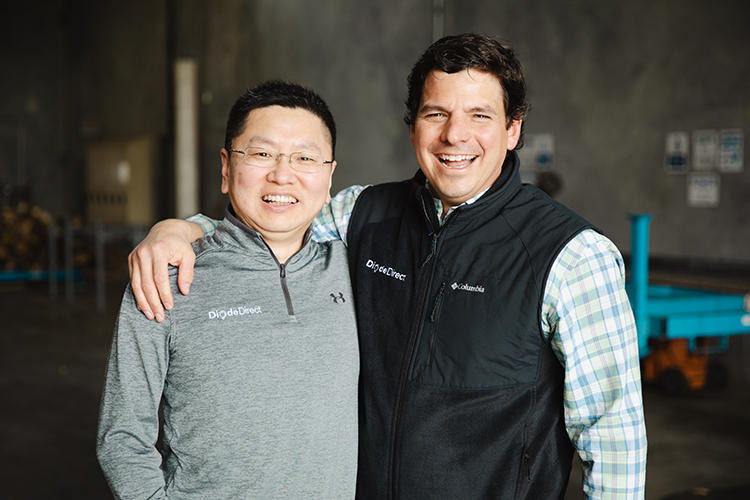
For Kevin Haar Jr. and Chris Jin, co-founders of Diode Direct, that shift raised a fundamental question: why had pricing and complexity in the construction lighting market drifted so far from the efficiencies seen elsewhere?
Rewiring tradition: Two entrepreneurs reshape St. Louis’ electrical supply market
To understand their perspective, it helps to look at the paths that led them there.
Haar, a St. Louis native and Washington University graduate, began his career in finance at Morgan Stanley. During his early tenure in New York, he witnessed the near-collapse of the financial system during the 2008–2009 crisis. Watching institutions restructure in real time—including Morgan Stanley’s own survival through outside investment—left a lasting impression on how industries evolve under pressure.
Jin’s background offered a complementary lens. With nearly 15 years of experience in manufacturing and product development prior to earning his MBA from Saint Louis University, he had worked closely with global supply chains, focusing on efficiency, cost control, and product optimization. Together, their experiences shaped a shared understanding: industries often accumulate layers that obscure value—and those layers can be rethought.
Later, their professional paths converged at a national e-commerce lighting company, where they helped scale commercial and industrial lighting sales through digital channels. That experience further exposed a disconnect between pricing in traditional construction supply and what could be achieved through more direct, streamlined models.
When they reconnected in 2023, the idea behind Diode Direct came into focus.
The company was built on a straightforward premise: simplify one of the most layered segments in construction by reducing middlemen and delivering lighting products direct to the contractor. In doing so, they aimed to realign cost with value – reducing distribution markups and focusing on quality and project execution.
In many ways, the model echoes the past. Like the Connellys delivering parts across St. Louis decades earlier, Diode Direct emphasizes responsiveness, accessibility, and local service—even as it operates on a national scale. The difference lies in how modern tools and global supply chains enable that service to be delivered with greater efficiency.
Rewiring tradition: Two entrepreneurs reshape St. Louis’ electrical supply market
Today, the company works with contractors from pre-construction through project completion, offering a single point of contact in a process that has historically involved multiple intermediaries. Simplifying the process has positive financial implications, notably for owners, contractors and developers.
According to the company, early growth has reflected strong market demand for this approach, with revenues reaching seven figures in its first year and expanding significantly thereafter. While the electrical supply market continues to evolve, their trajectory suggests a growing appetite for this more transparent model.
St. Louis has always been a place where industries are built by those willing to rethink how things are done. From the early days of organized electrical labor to the rise of family-run supply houses, and now to a new generation of entrepreneurs, the throughline remains the same: innovation grounded in practical experience.
As the electrical supply market continues to shift, the question is no longer whether it will change—but how. And in a city with as much history in the trade as St. Louis, that change is likely to continue blending tradition with reinvention.
Diode Direct provides lighting packages nationwide. For more information, contact sales@diodedirect.com.